
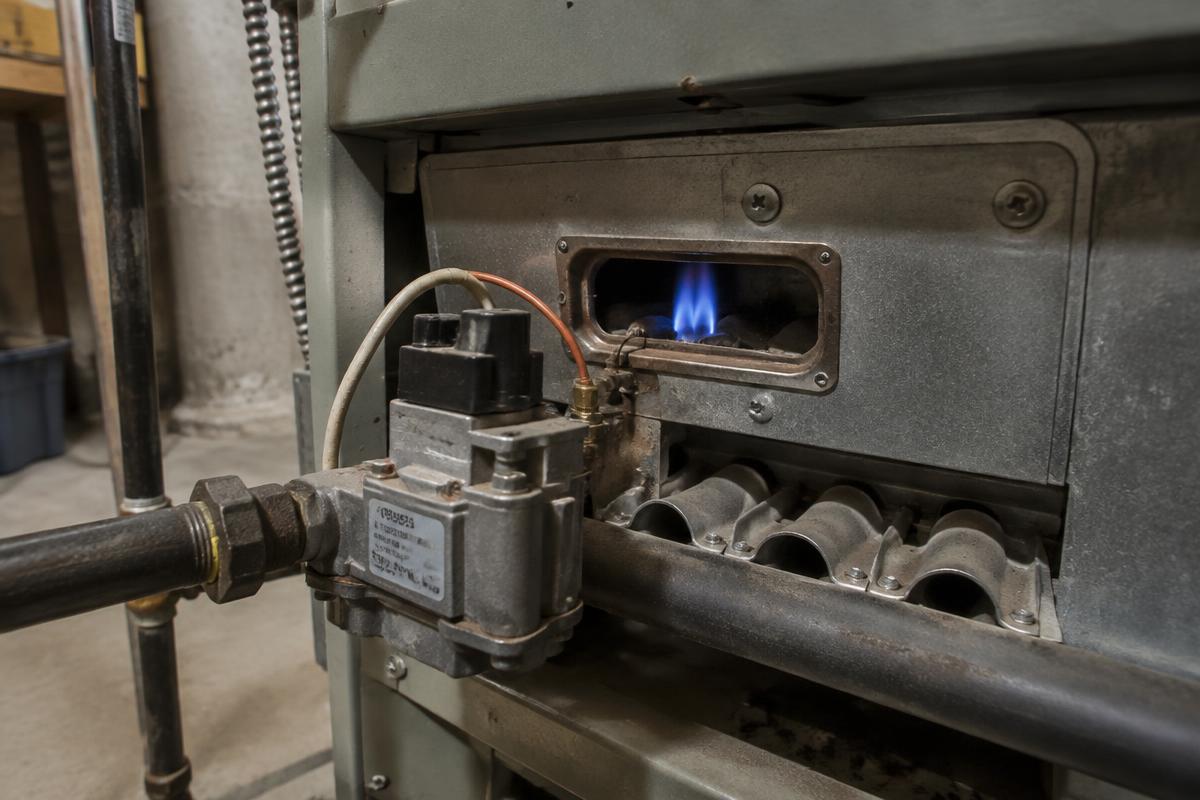
How Do You Light a Furnace Pilot Light?
Set the thermostat to off, turn the gas control knob to Off and wait five minutes, then set it to Pilot, hold the reset button while lighting the pilot, keep holding 30 seconds, and turn the knob to On. Follow the label on your furnace, since it governs.
When Should You Not Try This at All?
Stop and leave the house if you smell gas, hear hissing, or feel lightheaded. From outside, call your gas utility's emergency line and then call for service. Do not flip switches or use a phone inside the house.
Also stop if you see soot around the burner, a yellow or orange flame instead of blue, water standing around the furnace base, or a cracked looking heat exchanger. Carbon monoxide is odorless, so a working CO alarm on every level is not optional. The U.S. Consumer Product Safety Commission has the symptoms and placement guidance.
Does Your Furnace Even Have a Pilot Light?
Standing pilots are mostly found on furnaces built before the early 1990s. Newer furnaces use electronic ignition with either a hot surface igniter or an intermittent spark. There is no flame to relight on those, and searching for one wastes a cold evening.
If your furnace has no visible small flame and no gas control knob marked Off, Pilot, and On, it is an electronic ignition unit. Work through furnace not turning on instead.
What Are the Step by Step Instructions?
- Set the thermostat to Off.
- Find the gas control valve near the bottom of the furnace and read its label.
- Turn the knob to Off and wait five full minutes so any gas clears. Do not shortcut this.
- Turn the knob to Pilot.
- Press and hold the reset button while holding a long lighter at the pilot opening.
- Keep holding for about 30 seconds after it lights so the thermocouple heats up.
- Release, then turn the knob to On and set the thermostat back to heat.
If the flame dies the moment you release the button, the thermocouple is usually the reason.
Why Does the Pilot Light Keep Going Out?
Common causes, roughly in order:
- Failing thermocouple. It senses the flame and holds the gas valve open. Worn ones stop sending the signal.
- Dirty pilot orifice. Dust and scale weaken the flame until it cannot hold.
- Draft. A strong downdraft in the flue or a nearby vent blows it out.
- Failing gas valve. Less common and not a homeowner repair.
- Flue or venting problem. This one is a safety issue, not an inconvenience.
A pilot that needs relighting more than once a season is telling you something. Related symptoms show up in short cycling and cold air from the vents.
What Does This Repair Usually Cost?
A thermocouple replacement in Central Illinois typically runs $150 to $300 including the part. A pilot assembly cleaning and adjustment usually falls in the same range. A gas valve replacement generally runs $400 to $800. If the furnace is 20 years old and parts are scarce, the honest conversation is about repair versus replacement.
These are typical ranges for homes in our area, not a quote. You get a firm price in writing before any work starts.
Who Handles Pilot Light Problems in Pekin and Peoria?
Trouble Free Heating, Cooling & Plumbing services gas furnaces across Pekin, Peoria, Morton, and East Peoria. We test the thermocouple, check the flame, and verify safe venting rather than just relighting it and leaving.
If you are without heat, call (309) 347-5309 or request furnace service. A real person answers our phone 24/7, gathers the details, and helps coordinate the next available technician. Response times vary by technician availability, call volume, weather, travel conditions, and the urgency of existing calls.