
What's the Difference Between Hard Water and Soft Water?
What Does Hard Water Do to Your Plumbing and Appliances?
How Does Hard Water Affect Your Skin and Hair?
How Does a Water Softener Fix Hard Water?
What's the Difference Between a Water Softener and a Water Filter?
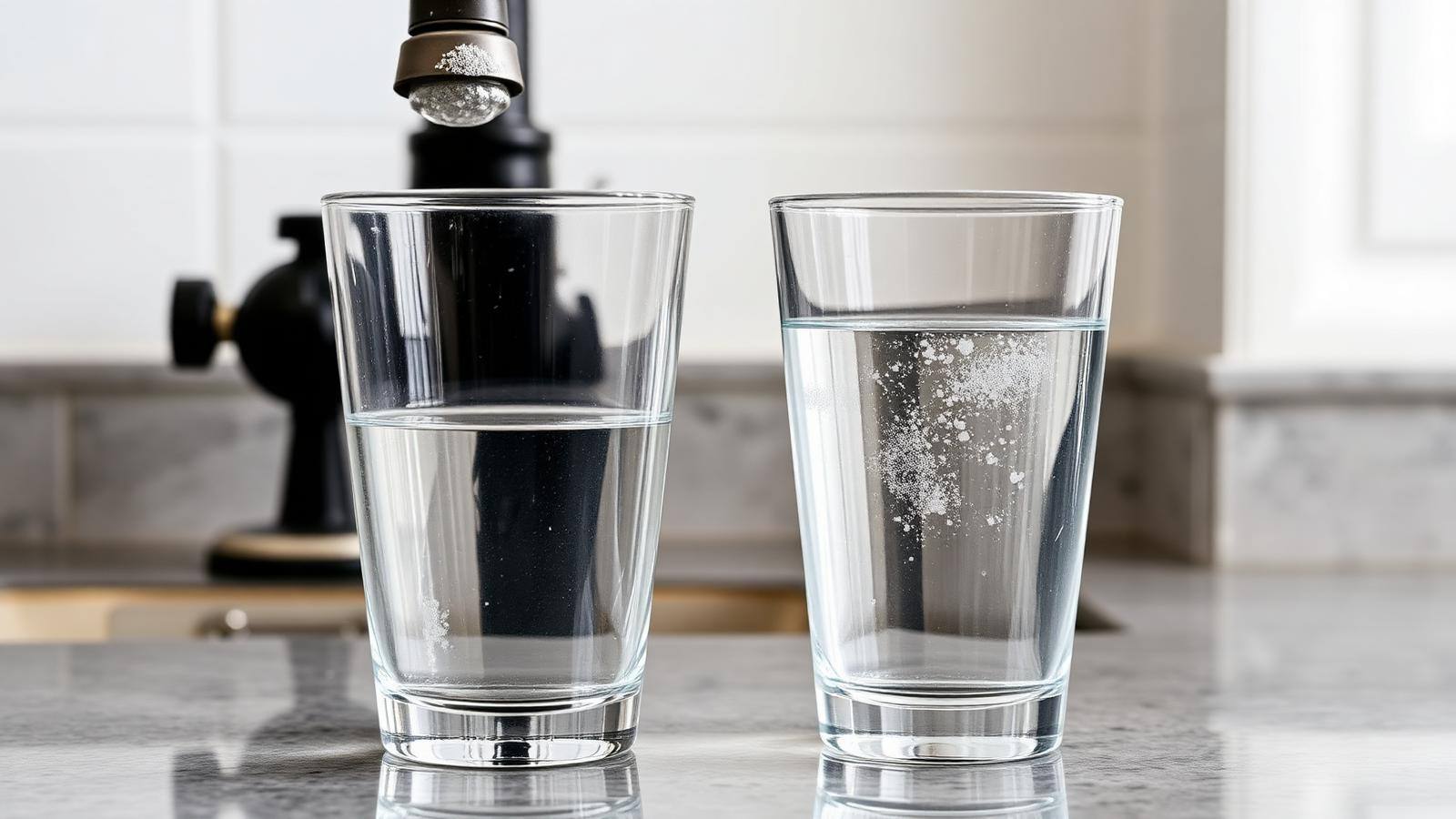
Hard Water vs Soft Water: Side by Side
Here is the practical difference in a home, not a lab:
| What you notice | Hard water | Soft water |
|---|---|---|
| Faucets and shower doors | White crust and spots | Stays clear |
| Soap and shampoo | Poor lather, uses more | Lathers easily, uses less |
| Skin and hair after a shower | Dry, filmy, flat | Softer feel |
| Laundry | Stiff, dingy, wears faster | Softer, colors hold longer |
| Water heater | Scale on the elements, shorter life | Runs cleaner, lasts longer |
| Dishes | Cloudy film and spots | Clear |
| Taste | Slightly mineral | Slightly flat to some people |
How Hard Is Your Water? The Hardness Scale Explained
Hardness is measured in grains per gallon (GPG) or milligrams per liter (mg/L). The U.S. Geological Survey uses these categories:
| Classification | mg/L | Grains per gallon |
|---|---|---|
| Soft | 0 to 60 | 0 to 3.5 |
| Moderately hard | 61 to 120 | 3.6 to 7.0 |
| Hard | 121 to 180 | 7.1 to 10.5 |
| Very hard | Over 180 | Over 10.5 |
Most Central Illinois homes test in the very hard range because our groundwater moves through limestone bedrock. That is the reason scale shows up here faster than it does for family in other parts of the country.
How Do You Test Your Water Hardness at Home?
Three ways, cheapest first:
- The soap test. Put a few drops of pure liquid soap in a bottle of tap water, shake it, and look. Lots of suds and clear water means soft. Few suds and cloudy water means hard.
- A test strip kit. Available at any hardware store for a few dollars. Dip, wait, and compare to the chart for a GPG number.
- Your water utility report. Public systems publish an annual water quality report that lists hardness. Private well owners need their own test.
If the number comes back above 7 GPG, scale is already forming inside your pipes and water heater.
Is Hard Water Safe to Drink?
Yes. Calcium and magnesium in hard water are not a health hazard, and the EPA does not regulate hardness as a contaminant. The problem is mechanical, not medical: scale coats pipes, water heater elements, dishwashers, and washing machines, and it shortens their life. If you want better tasting drinking water on top of softening, that is a filtration question, and our guide on reverse osmosis water covers it.
Does a Water Softener Make Water Taste Salty?
No. A properly sized and set softener uses salt to clean its resin bed, then rinses that brine down the drain. The water reaching your tap carries a very small amount of sodium, not a salty taste. If your softened water actually tastes salty, the unit is stuck in regeneration or is set wrong, and it needs service.
Fix Hard Water in Your Central Illinois Home
If you are tired of scale, spotty dishes, and a water heater that keeps failing early, a whole-home softener solves the cause instead of the symptoms. We install and service softeners and whole-home filtration across Pekin, Peoria, Morton, Washington, East Peoria, and Canton, and new installations come with a free estimate.