
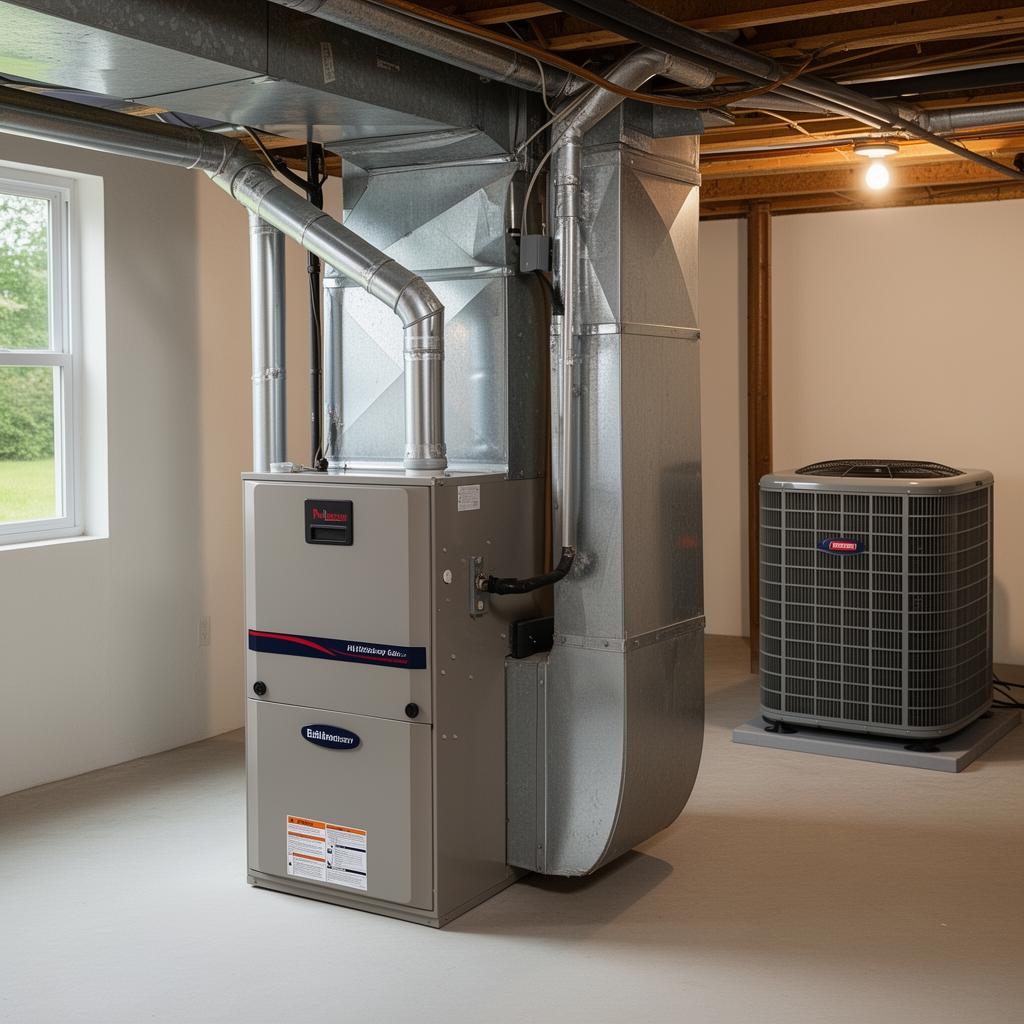
Why Should You Replace Your Furnace and AC at the Same Time?
Replacing your furnace and AC together saves money on labor, guarantees accurate efficiency ratings, and makes sure the new refrigerant monitoring system can run the furnace blower if a leak is detected. It also avoids cabinet size mismatches that can block the new indoor coil from fitting in your existing furnace.
What Are the Signs You Need Both a New Furnace and AC?
The biggest clue is age. If your furnace is over 15 years old and your AC is over 12 years old, both are living on borrowed time. Other signs include rising summer and winter utility bills, rooms that never feel the same temperature, and repair calls that are becoming an annual routine. If you are already pricing one, you are usually better off pricing both. Our guide on whether to repair or replace your furnace walks through the same decision from the heating side.
What Problems Happen When You Replace Only One Unit?
Replacing just one unit leaves you with a mismatched system. Your new AC may be rated at 16 SEER2, but when paired with an old furnace blower and coil cabinet, it cannot hit that number in the real world. The U.S. Department of Energy explains that split-system efficiency ratings assume the indoor and outdoor units are designed to work together.
Then there is the new refrigerant issue. Modern AC systems use A2L refrigerants that require a leak detection monitor. If a leak occurs, the monitor tells the furnace blower to run and dilute the refrigerant in your home. An older furnace cannot receive that command. It also cannot power the new coil or fit the larger cabinet many modern systems need.
Finally, you pay for labor twice. Pulling and reinstalling a furnace or air handler is a big part of the job. Doing both at once saves on that labor and gives you one warranty that covers the whole system.
How Do Matching Efficiency Ratings Save You Money?
Air conditioner efficiency ratings like SEER2 and EER are measured as a complete system. The outdoor condenser, indoor evaporator coil, and furnace blower are tested together. When you replace only the outdoor unit, the label on the box does not reflect what you actually get.
For example, a 16 SEER2 AC paired with a 20-year-old furnace blower may perform closer to 13 or 14 SEER2 in your home. That means higher electric bills and less cooling than you paid for. The ENERGY STAR program recommends replacing both indoor and outdoor units at the same time to realize the full efficiency and comfort benefits.
Matched systems also communicate better. Variable-speed blowers and two-stage compressors need matched control boards to modulate properly. Without that pairing, you are paying for features you cannot use.
Why Does New Refrigerant Require a Matched Furnace?
New residential AC equipment is moving to lower-global-warming-potential refrigerants classified as A2L, such as R-454B and R-32. These refrigerants are mildly flammable, so new safety standards require leak detection sensors and automatic mitigation. When a leak is detected, the system is designed to turn on the furnace blower to circulate and dilute the refrigerant.
That only works if your furnace has the right control board, wiring, and blower design to receive the signal. Many furnaces built before 2023 do not. If you install a new AC on an old furnace, the safety system may not function as intended. This is one reason manufacturers and the EPA refrigerant transition guidelines treat indoor and outdoor units as a matched pair.
What Compatibility Issues Stop a Mix-and-Match Install?
Even when efficiency is not the issue, physical fit can be. Older furnaces are not always the same width, depth, or height as new ones. Some very old cabinets are narrower or deeper than today's standard sizes. If your new AC coil is wider or taller than the old one, it may not sit on top of the furnace properly.
This is especially common in counterflow installations, where the furnace sits below the coil and air flows upward. The new, larger coils often need a shorter furnace to fit in the same space. If you keep the old furnace, the coil may not fit at all, or the airflow will be restricted and noisy. We see this in older homes in Peoria, Pekin, and Morton where the mechanical room was built around equipment from the 1990s or early 2000s.
See how a proper furnace installation and AC installation are sized for your home.
How Does a Heat Load Calculation Make Sure Your System Is Sized Properly?
A heat load calculation, also called a Manual J load calculation, measures how much heating and cooling your home actually needs. It looks at square footage, ceiling height, insulation levels, window size and direction, air leakage, ductwork, and even how many people live in the house. Without it, a contractor is guessing.
Guess too high and you get a system that short-cycles, wastes energy, and wears out fast. Guess too low and your home never feels comfortable on the hottest or coldest days. At Trouble Free Heating, Cooling & Plumbing, we run this calculation on every install so the furnace and AC we recommend matches your family's comfort needs and your home's real requirements.
What Happens If a Furnace or AC Is the Wrong Size?
An oversized system heats or cools the house quickly, then shuts off before it can remove humidity or distribute air evenly. The result is hot and cold spots, muggy summers, and a system that turns on and off so often it breaks sooner. An undersized system runs non-stop, struggles to keep up, and still leaves you uncomfortable.
Both mistakes cost you money and comfort. A proper heat load calculation prevents that by sizing the equipment to the home instead of swapping in whatever unit was there before.
How Does Trouble Free Handle Furnace and AC Replacement?
At Trouble Free Heating, Cooling & Plumbing, we perform a heat load calculation on every install to make sure the unit we put in is sized properly and meets your family's comfort needs. We measure your home, check your ductwork, and make sure the new indoor coil, furnace, and outdoor condenser all fit and communicate properly. We also make sure the new refrigerant safety monitoring is wired and tested before we leave.
We install complete HVAC systems across Pekin, Peoria, Morton, Washington, East Peoria, Canton, and surrounding Central Illinois communities. Free estimates are available for new installations.
To keep your home trouble-free, call (309) 347-5309 or schedule your free estimate today.